Back to School Mazes Puzzles Solution
When the calendar flips to late summer, educators, parents, and caregivers begin planning for one of the most consequential transitions of the year: back to school. It’s not just about new notebooks and lunchboxes—it’s about re-engaging young minds after a break, rebuilding focus, and reinforcing foundational cognitive skills in ways that feel inviting, not intimidating. That’s where Back to School Mazes Puzzles Solution steps in—not as a filler activity, but as a purposefully designed learning tool rooted in cognitive science and classroom-tested play.
Mazes are more than winding lines on paper. They’re structured problem-solving environments that ask children to plan, anticipate, self-correct, and persist—all without explicit instruction. Each labyrinth requires sustained attention, spatial reasoning, and working memory. A child tracing a path from start to finish isn’t just “killing time”; they’re strengthening neural pathways associated with executive function—skills directly linked to academic readiness, reading comprehension, and even math fluency.
Why These Mazes Stand Out Among Back-to-School Resources
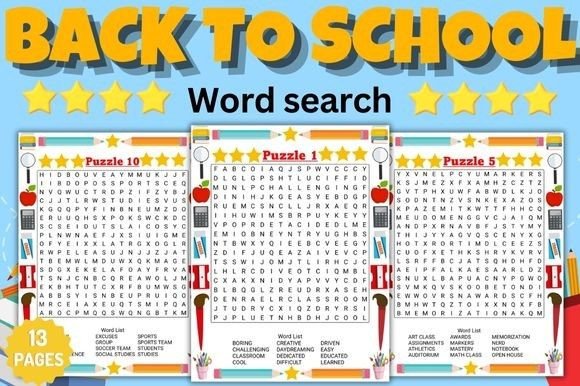
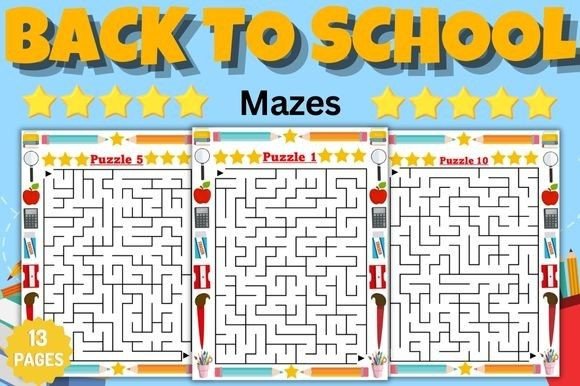
Not all mazes deliver equal value. Generic clipart-style puzzles often lack developmental intentionality—too easy to bore, too chaotic to build confidence. The Back to School Mazes Puzzles Solution set avoids that pitfall. Its 13 pages feature clean, high-contrast designs sized at 8.5 x 11 inches—optimized for standard printers and classroom copy machines. Each maze increases subtly in complexity: early pages use wide paths and clear visual cues (like backpacks, apples, or pencils as landmarks), while later ones introduce branching logic and multi-step decision points. This scaffolding supports differentiated learning—ideal for mixed-age groups or varying skill levels in homeschool or after-school settings.
The inclusion of both PDF and PNG files adds practical flexibility. Educators can embed mazes into digital lesson slides or interactive whiteboard activities. Parents can print single copies for quiet car rides or batch-print for weekly learning kits. Because the files are high-resolution and print-ready, there’s no need for image editing or resizing—saving valuable prep time during an already demanding season.
Real-World Uses Beyond the Classroom
For teachers, these mazes serve dual roles: as low-prep warm-ups that settle students’ energy before a lesson, and as informal formative assessments. Watch how a child navigates a dead-end—they might backtrack methodically, erase and restart, or pause to scan ahead. Those behaviors reveal real-time insights into their metacognitive habits: Do they monitor their own thinking? Can they adjust strategy mid-task? That observational data is harder to gather from standardized worksheets.
Homeschooling families appreciate the open-ended nature of the resource. One parent shared how she laminates the mazes and uses dry-erase markers—turning each puzzle into a reusable center activity. Another used the apple- and notebook-themed designs to launch a unit on school supplies, pairing mazes with vocabulary building and descriptive writing prompts (“What would your backpack say if it could talk?”). Creativity isn’t just supported—it’s invited.
Therapists and special educators also find utility here. Children with ADHD or sensory processing differences often respond well to structured visual tasks that offer clear goals and immediate feedback. The predictable format reduces anxiety, while the physical act of tracing or coloring the path provides gentle motor engagement. Importantly, the mazes avoid overstimulating graphics or dense text—making them accessible without diluting challenge.
Who Benefits Most—and When It Might Not Fit
This resource shines for adults supporting children aged 5–10—the sweet spot where symbolic thinking, fine motor control, and independent problem solving converge. It’s especially helpful for those managing multiple learners: tutors juggling different grade levels, childcare providers preparing themed activity bins, or small business owners creating printable subscription boxes for families.
That said, it’s not a standalone curriculum. If you’re seeking comprehensive lesson plans with answer keys, teaching scripts, or alignment to specific standards (e.g., Common Core or state frameworks), this set doesn’t provide that depth. It’s a focused tool—not a full program. Likewise, for children significantly below or above the target age range, adjustments may be needed: younger kids may benefit from verbal guidance or tracing with fingers first; older ones might enjoy extending the activity by designing their own mazes using the included templates as inspiration.
Practical Tips for Getting the Most From Your Download
- Print smart: Use draft mode for trial runs, then switch to best quality for final copies—especially if distributing to multiple families or classrooms.
- Extend the learning: After completing a maze, ask open-ended questions: “What was the trickiest part? How did you figure it out?” This builds articulation and reflection—key components of deeper learning.
- Pair intentionally: Combine a pencil-themed maze with a handwriting practice sheet, or use the clock-themed version alongside a time-telling lesson. Cross-linking reinforces concepts without repetition fatigue.
- Track progress informally: Keep a simple log noting which mazes took longer, which prompted frustration versus focus, or which sparked unexpected questions. Over time, patterns emerge—helping you tailor future support.
The Back to School Mazes Puzzles Solution works because it respects both the child’s need for playful engagement and the adult’s need for reliability and ease. There’s no assembly, no login, no subscription—just download, print, and observe what happens when curiosity meets structure. And because it’s digital, there’s no inventory stress, shipping delay, or environmental cost. You get unlimited prints, meaning one purchase serves your whole classroom, co-op, or family for years—even as kids revisit favorites at new developmental stages.
Still, usefulness depends on context. If you’re building a high-tech hybrid learning environment, consider how these mazes integrate with your existing platforms. Can they be uploaded to Seesaw or Google Classroom as PDF assignments? Yes—thanks to the file formats provided. Are they compatible with screen readers or adaptive devices? Not natively, though printed versions can be paired with tactile enhancements (e.g., raised-line stickers) for some learners.
We invite honest, constructive feedback—not just ratings, but notes on how you’re using the mazes, what worked, and where adaptations helped. That kind of insight helps refine resources for everyone. Because ultimately, the goal isn’t just to sell puzzles. It’s to support the quiet, daily work of helping young minds grow stronger, more flexible, and more confident—one thoughtful turn at a time.