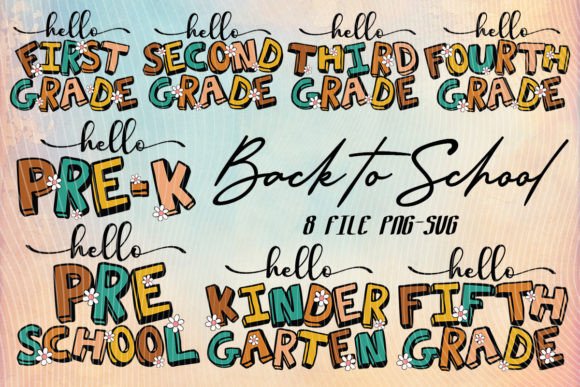
Hello School Back to School T-shirt SVG
If you're designing merchandise for the back-to-school season—whether for an online store, school fundraiser, teacher appreciation initiative, or creative side hustle—the Hello School Back to School T-shirt SVG is a practical, production-ready asset worth evaluating. It’s not a physical product, nor a subscription or service—it’s a digital design file intended for immediate use in cutting machines (like Cricut or Silhouette) or print-on-demand platforms. Its value lies in its specificity, resolution, and adaptability across common merch formats.
What You’re Actually Getting
The Hello School Back to School T-shirt SVG package includes two core files: an SVG vector file and a high-resolution PNG (5000 × 5500 pixels at 300 DPI). The SVG is scalable without quality loss—ideal for vinyl cutting, heat transfer application, or resizing across apparel sizes. The PNG is a finished raster version, optimized for direct upload to platforms like Amazon Merch, Redbubble, Teespring, or Shopify-integrated POD services. Importantly, neither file is editable beyond basic scaling or color adjustment in standard design software; they arrive as final, production-locked assets.
This distinction matters. Unlike layered PSD or AI files meant for customization, this set prioritizes speed and consistency over flexibility. That makes it well-suited for users who need reliable, on-brand output—not those planning extensive redesigns or multilingual variants.
Quality and Technical Execution
The 5000 × 5500 pixel PNG resolution exceeds typical POD requirements (most require only 4000 × 5000 at 300 DPI for large-format prints), meaning it holds up cleanly even on oversized posters or tote bags. Text remains crisp, edges are smooth, and anti-aliasing appears well-managed—no visible pixelation or jagged curves when zoomed or printed at scale. The SVG path data is clean and minimal, with no unnecessary nodes or embedded raster elements—a sign of thoughtful vector construction rather than auto-traced output.
Color-wise, the design uses a limited, cohesive palette—typically school-appropriate tones like navy, kelly green, warm yellow, or classic red/white/blue combinations. This supports easy recoloring in most cutting or design apps while maintaining visual balance. There’s no transparency or complex blending modes that could cause rendering issues across different platforms or devices.
Real-World Use Cases and Workflow Fit
For small business owners launching a seasonal collection on Amazon Merch or Etsy, the Hello School Back to School T-shirt SVG reduces time-to-market significantly. You avoid hiring a designer for a simple, thematic concept—and sidestep the trial-and-error of sourcing low-res or overused clipart. Upload the PNG directly, pair it with a clean mockup, and list within minutes. Similarly, educators organizing spirit wear for PTA events can cut vinyl decals from the SVG and apply them to t-shirts, water bottles, or classroom signage without needing advanced graphic design skills.
Freelance designers working with multiple K–12 clients may find this file useful as a starting point—not for resale, but for rapid prototyping. For example, adding a school mascot or name beneath the “Hello School” headline (using compatible fonts) maintains brand alignment while personalizing the offering. Just note: the file itself isn’t licensed for redistribution or white-label resale, so modifications must remain client-specific.
Where It Excels—and Where It Doesn’t
Strengths include reliability, format readiness, and thematic clarity. The phrase “Hello School” is friendly yet professional—neither too juvenile nor overly corporate—making it appropriate for elementary through high school contexts. It avoids dated trends (e.g., excessive gradients, neon outlines, or meme references), supporting longevity across multiple academic years.
Limits are equally clear. There’s no alternate layout (e.g., stacked vs. horizontal text), no companion icons (buses, apples, pencils), and no built-in bilingual options. If your audience requires Spanish-language versions or accessibility-focused high-contrast variants, you’ll need to create those separately. Also, while the design works across t-shirts, mugs, and posters, it wasn’t optimized for curved surfaces (like travel mugs) or seam-aligned apparel printing—so placement testing is still recommended before bulk orders.
Audience Alignment: Who Benefits Most?
The Hello School Back to School T-shirt SVG serves creators and operators who prioritize efficiency, consistency, and contextual appropriateness over maximal customization. Think:
- Educators and PTA coordinators managing low-budget, time-sensitive spirit campaigns;
- Small e-commerce sellers focusing on seasonal niches without in-house design capacity;
- Print-on-demand entrepreneurs building themed collections around academic calendars;
- Marketing professionals supporting back-to-school promotions for education-adjacent brands (e.g., tutoring services, stationery lines, or edtech tools);
- Hobbyists with cutting machines who want polished, ready-to-cut designs without learning vector illustration.
It’s less ideal for agencies building fully custom brand identities or designers requiring layered source files for client revisions. Likewise, if your project demands ADA-compliant typography sizing or multistate curriculum alignment (e.g., Common Core vs. state-specific standards), the design itself won’t address those needs—it’s a visual asset, not a pedagogical tool.
Practical Recommendations for Best Results
Before deploying the Hello School Back to School T-shirt SVG, test both file types in your intended workflow. Import the SVG into your cutting software and verify all paths release cleanly—especially if using older machine firmware. For print, open the PNG in Photoshop or Affinity Photo and confirm no unintended compression occurred during download (check file properties for actual DPI and dimensions).
When listing on marketplaces, pair the design with contextually relevant titles and backend keywords—e.g., “back to school teacher shirt,” “elementary school spirit wear,” or “first day of school gift”—but avoid stuffing. Real search behavior shows users often combine functional terms (“vinyl cut file”) with seasonal intent (“2024 back to school”).
Finally, consider how the design fits your broader visual ecosystem. Does it complement your existing color scheme? Does it scale appropriately alongside logos or slogans you plan to add? A quick side-by-side comparison with your brand guidelines takes under five minutes—and prevents mismatched launches.
Sharing Your Work: Why It Matters
The invitation to “SHARE YOUR PROJECT MADE WITH THIS PRODUCT” isn’t just marketing—it reflects a practical truth about digital design assets: real-world application reveals nuances no spec sheet can capture. A teacher’s photo of the design on handmade canvas bags may highlight durability after repeated washing. A seller’s screenshot of Amazon analytics might show unexpected demand in rural districts. These contributions help others assess fit, troubleshoot, and identify unanticipated use cases—like applying the SVG to chalkboard-style classroom door signs or laminated hallway banners.
That kind of peer-validated insight is rare in digital asset markets. When users share outcomes—not just ratings—they collectively build a more accurate picture of performance, limitations, and adaptability. It transforms a static file into part of a living resource network.