School Stuff Word Search Back to School
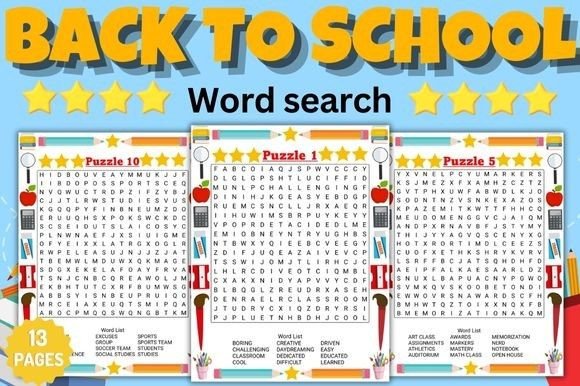
For educators, curriculum designers, homeschooling parents, and educational content creators, finding high-quality, ready-to-use vocabulary resources that balance engagement with pedagogical intent is a persistent challenge. School Stuff Word Search Back to School meets that need with focused utility—not as a novelty item, but as a purpose-built vocabulary reinforcement tool designed for the first weeks of the academic year.
A Practical Vocabulary Anchor for Early Academic Routines
This resource isn’t just another themed word search. It’s structured around a curated list of school-related terms—words like “notebook,” “backpack,” “principal,” “cafeteria,” “homework,” and “attendance”—selected for relevance across grade levels K–5 and adaptable for ESL learners or students developing academic language fluency. The puzzle grid supports standard search directions (horizontal, vertical, diagonal), reinforcing pattern recognition and visual scanning skills while anchoring domain-specific vocabulary in active recall.
Unlike generic word searches with loosely connected terms, School Stuff Word Search Back to School centers on functional classroom lexicon: words students hear daily, see on schedules and signage, and use when navigating routines. That specificity increases its instructional ROI—especially during orientation, morning meetings, or literacy warm-ups where building shared understanding matters more than entertainment value.
Production Quality Designed for Real-World Use
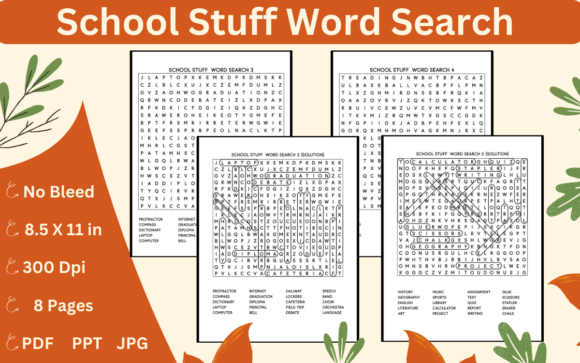
The download includes three file formats: PDF (print-ready), JPG, and PNG. All assets are sized at 8.5 × 11 inches and rendered at 300 DPI—ensuring crisp text and clean lines whether printed on standard copy paper or projected digitally. The black-and-white interior avoids ink waste and maintains readability under varied lighting conditions, including classroom projectors or low-resolution displays.
Eight pages total include multiple puzzle variations—each with unique layouts and word placements—plus answer keys. This avoids repetition fatigue across classrooms or multi-week usage. There’s no bleed, so margins remain consistent when trimming or binding into student folders or teacher resource binders. The absence of color or decorative flourishes isn’t a limitation; it’s a design choice that prioritizes clarity, accessibility, and universal compatibility with district printing policies and assistive technologies.
Who Benefits—and How They Use It
Educators integrate School Stuff Word Search Back to School into transition activities during the first week of term—pairing it with discussions about classroom expectations, school roles, or community-building exercises. One third-grade teacher uses it as a “vocabulary scavenger hunt”: students locate words, then write sentences using two terms in context before sharing aloud. Another middle school special education team adapts the puzzles for small-group instruction, adding sentence frames or matching definitions after completion.
Homeschooling families appreciate the plug-and-play usability—no lesson planning required. A parent of two used the eight-page set across two consecutive Augusts: one child completed puzzles independently; the other worked alongside a sibling, practicing letter-sound correspondence and spelling patterns. The consistent format helped establish predictable learning rhythms without relying on screens.
Content creators and publishers find value in the asset’s licensing flexibility (assuming standard commercial use rights apply). The PNG and JPG files allow direct embedding into digital newsletters, printable subscription kits, or supplemental activity packs sold via Etsy or Teachers Pay Teachers. Because all files are cleanly formatted and resolution-optimized, they integrate seamlessly into branded templates without requiring redesign or upscaling.
Strengths Beyond the Grid
- Consistency: Every puzzle maintains uniform font size, spacing, and grid density—critical for readability among emerging readers or students with visual processing considerations.
- Reliability: Answer keys are accurate and clearly labeled, eliminating time spent verifying solutions mid-lesson.
- Flexibility: No prerequisite knowledge is assumed. Students can engage with the puzzle before formal vocabulary instruction begins—making it equally useful as a pre-assessment, review tool, or early-finisher activity.
- Long-term utility: While themed for back-to-school, the core vocabulary remains relevant year-round. Terms like “syllabus,” “assignment,” or “deadline” appear in later iterations, supporting sustained academic language development beyond September.
Realistic Considerations and Limitations
It’s important to acknowledge what School Stuff Word Search Back to School does not do. It doesn’t replace explicit vocabulary instruction, scaffolded writing practice, or oral language development. As a standalone activity, it won’t address phonemic awareness or morphology in depth. Its effectiveness depends on intentional integration—e.g., pairing puzzle completion with follow-up discussion, definition practice, or real-world application (e.g., “Find ‘library’—where is ours? What rules apply there?”).
Also, while the black-and-white format enhances accessibility and print efficiency, it may feel visually minimal to users accustomed to highly illustrated resources. Educators working with younger learners or those needing higher visual stimulation might supplement with icons or color-coding—but that’s an intentional design gap, not a flaw. The resource assumes the user brings contextual scaffolding; it doesn’t attempt to deliver it.
How It Fits Into Broader Educational Workflows
In curriculum mapping, School Stuff Word Search Back to School functions best as a micro-tool within larger units on community, routines, or academic identity. For example, a literacy coach recommended embedding one puzzle per week across a four-week “School Systems” unit—each paired with a short nonfiction text about school roles, followed by a collaborative glossary-building activity. That approach leverages repetition without redundancy and connects isolated words to authentic contexts.
From a workflow perspective, its value lies in time saved—not just in preparation, but in cognitive load reduction. When teachers have 12 minutes between periods to prepare for the next class, pulling a ready-printed, standards-aligned vocabulary activity from a trusted folder is materially different from generating or adapting one from scratch. That consistency compounds across a school year, especially for specialists supporting multiple grade levels or rotating classrooms.
Ultimately, School Stuff Word Search Back to School earns its place not because it’s flashy or comprehensive, but because it solves a narrow, recurring problem well: helping students recognize, recall, and begin internalizing the language of school—efficiently, reliably, and without distraction. For professionals who prioritize function over flair, and substance over scale, it’s a quietly effective component—not a centerpiece, but a dependable one.