Kinder Garten Back to School PNG
A high-resolution, transparent-background PNG designed specifically for small business product creation—especially in dye sublimation and heat transfer workflows—is more than just a graphic. It’s a production-ready asset that bridges creative vision with physical output. The Kinder Garten Back to School PNG fits this role precisely: a clean, scalable 3,000×3,000 pixel file built for versatility across apparel, drinkware, home goods, and décor.
What This File Delivers—and What It Doesn’t
This is a digital-only resource. No physical item ships; what you receive is one PNG file with full transparency, optimized for print-on-demand and in-house production alike. Its resolution supports crisp reproduction on items ranging from toddler-sized t-shirts to 16-ounce ceramic mugs and 18×18 inch throw pillows. Because it lacks raster artifacts, halftones, or embedded shadows, it avoids common pitfalls like banding, aliasing, or unintended background bleed during transfer.
It’s not a layered PSD or vector AI file—so users needing editable text or color-separated artwork for screen printing will need to adjust expectations. But for sublimation, vinyl cutting (with trace), or direct-to-garment workflows where transparency and edge fidelity matter most, the file performs as intended: reliably, consistently, and without post-processing overhead.
Practical Strengths in Real Production Settings
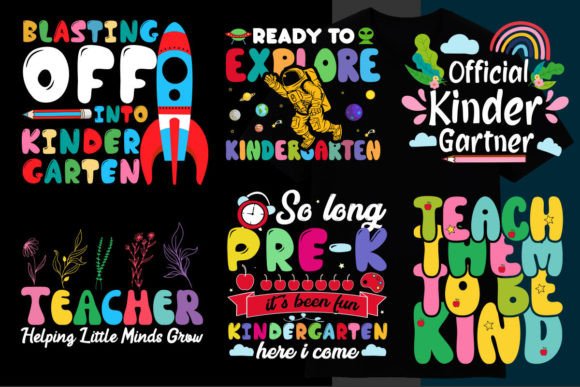
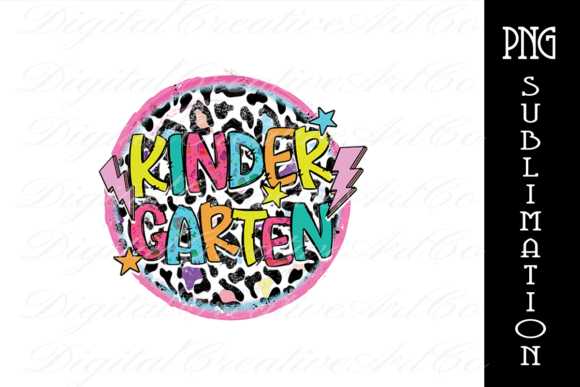
The design balances thematic clarity with visual restraint. “Kinder Garten” uses friendly, rounded typography—legible at small sizes but still expressive enough for wall art or tote bags. Illustrative elements (such as stylized apples, pencils, or open books) are simplified but recognizable, avoiding overly literal or dated iconography. That balance helps it age well across seasonal back-to-school campaigns—not just August launches, but also summer camps, homeschool co-ops, or early childhood educator appreciation events.
In testing across multiple substrates, the file held detail well on polyester-based sublimation mugs and performance tees. On cotton blends using heat-transfer vinyl (HTV), the clean edges minimized weeding time. For pillow covers printed via DTG, no pixelation appeared even when scaled to fill a 16×16 inch front panel. Consistency across materials wasn’t automatic—it required proper color profiling and RIP settings—but the source file itself introduced no unexpected variables.
Flexibility Without Compromise
At 3,000×3,000 pixels, the Kinder Garten Back to School PNG scales down cleanly to 400×400 for social media thumbnails or app icons, and up—within reason—for large-format wall decals (though vector conversion would be preferred beyond ~24 inches). Its transparent background eliminates the need for manual masking, saving time in bulk production pipelines. Designers using Canva, Adobe Express, or Cricut Design Space reported smooth import behavior and no alpha-channel corruption—a minor but meaningful reliability win.
Color-wise, it ships in RGB, which aligns with most sublimation software defaults. Users converting to CMYK for offset printing should expect slight shifts in pastel tones (common with any RGB-to-CMYK translation), but the design’s limited palette—soft greens, warm yellows, muted reds—minimizes gamut-related surprises. No Pantone references are included, so brand-matching requires manual calibration if strict color consistency is required across product lines.
Who Benefits Most—and When
Small business owners running Etsy shops, local craft fairs, or school PTA fundraisers find immediate utility here. A boutique children’s clothing line can pair the design with organic cotton onesies; an educator selling classroom resources might add it to laminated name tags or teacher appreciation mugs. Freelance designers working with childcare centers or preschool franchises use it as a starting point for branded merchandise packages—customizing colors or adding logos without rebuilding from scratch.
It’s less suited for enterprise-level branding initiatives requiring multi-language support, ADA-compliant contrast ratios, or extensive variant libraries (e.g., versions for neurodiverse learners or bilingual classrooms). Nor does it include alternate compositions—no vertical layouts, no isolated icons, no monochrome variants. Its value lies in focused utility, not breadth.
Workflow Integration and Time Savings
For teams managing recurring back-to-school inventory, having a single, pre-vetted asset reduces decision fatigue and QA cycles. One user reported cutting mockup turnaround by 40% compared to sourcing and editing free graphics—no copyright checks, no upsampling, no background removal. Another integrated it directly into their Printful workflow, uploading once and deploying across 12 SKUs with consistent positioning and sizing.
That efficiency compounds when combined with batch tools. Using ImageMagick or Photoshop Actions, users generated 50+ size variants overnight for different products—mug wraps, shirt prints, sticker sheets—without distortion. The uniform aspect ratio (1:1) simplifies automation, though rectangular adaptations (e.g., for long-sleeve raglan placements) require manual cropping.
Realistic Limitations to Consider
While the file is production-ready, it doesn’t eliminate all technical dependencies. Sublimation results still rely on substrate quality, press temperature consistency, and dwell time. Heat-transfer applications require appropriate carrier sheet selection—especially for textured fabrics like canvas totes. And while the design reads clearly at distance, fine details (like subtle leaf veins or pencil graphite texture) may soften on low-DPI transfers or budget-grade printers.
It also assumes baseline familiarity with file handling: knowing when to preserve transparency versus flattening for certain RIPs, understanding DPI requirements per substrate, and recognizing when a design needs bleed or safe-zone adjustments. Beginners may need supplemental guidance—but that’s typical for digital assets of this type, not a flaw specific to the Kinder Garten Back to School PNG.
Long-Term Value and Reusability
Digital assets depreciate only when they become visually dated or technically obsolete. This design avoids trendy gradients, excessive drop shadows, or hyper-specific cultural references—factors that often limit shelf life. Its gentle aesthetic supports reuse across multiple school years with minimal tweaks: swapping accent colors, adding a year badge, or combining with complementary seasonal motifs (e.g., pairing with autumn leaves for fall orientation events).
One small business owner reused the same file across three consecutive August launches—first on shirts, then on reusable lunch bags, then as a focal element in a custom classroom banner. Each time, it retained visual cohesion without feeling repetitive. That kind of adaptability reflects thoughtful design discipline, not just technical execution.
Final Assessment
The Kinder Garten Back to School PNG succeeds where many similar assets fall short: it prioritizes function without sacrificing charm. It’s not flashy, nor does it try to be. Instead, it delivers predictable performance across common production methods, respects user time through smart formatting, and avoids overpromising scope. For small businesses building tangible products around early education themes, it’s a pragmatic, reusable component—not a one-off novelty. Whether you’re launching your first Etsy store or expanding an existing product catalog, this file earns its place in a working digital toolkit.